
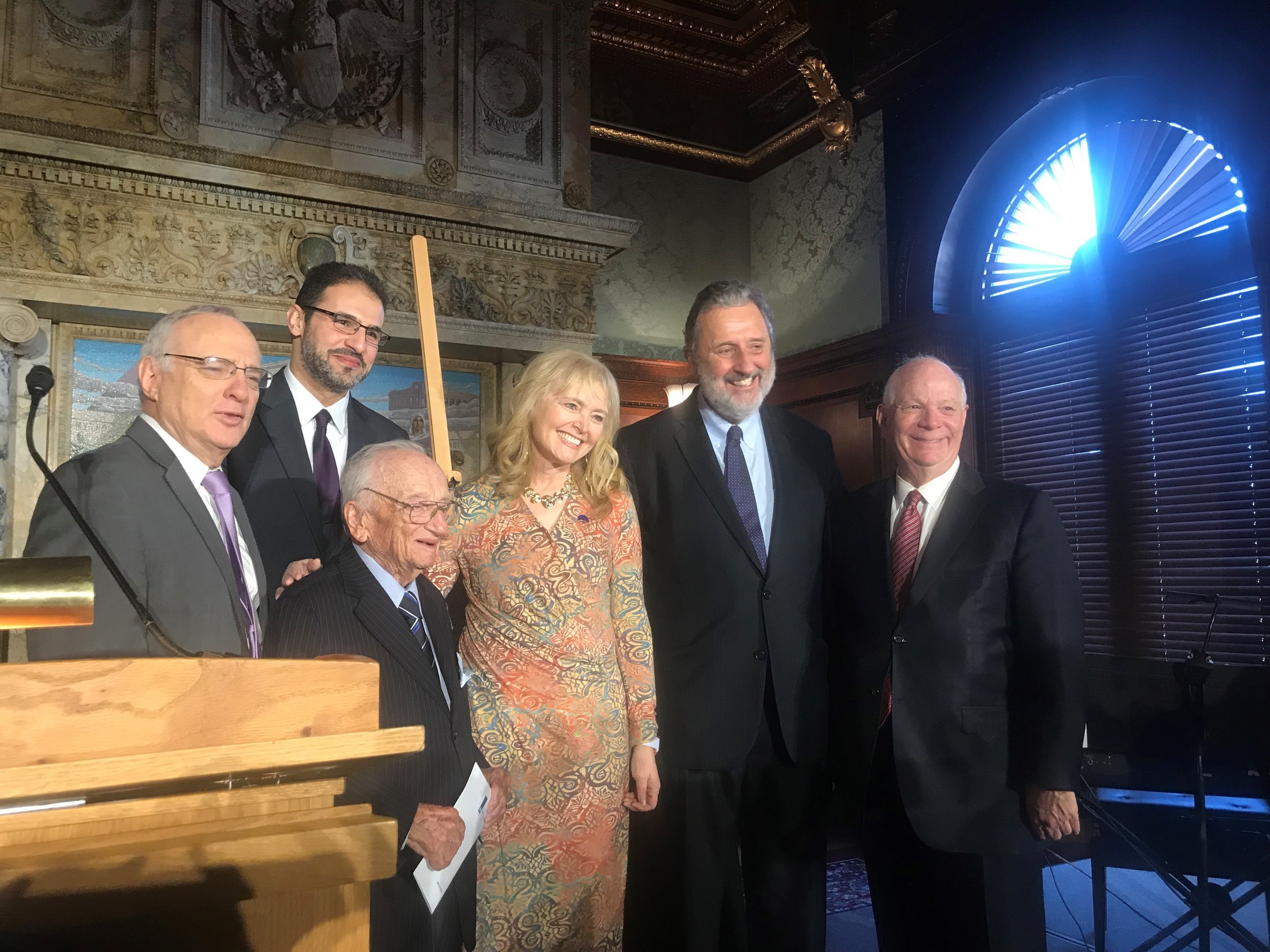
the Lantos Foundation was proud to once again take part in the 2019 Anne Frank Award Ceremony where Ben Ferencz, the Chief Prosecutor for the Einsatzgruppen Trial held at Nuremberg, was honored for his historical heroism and his lifetime of work dedicated to the Rule of Law. Ben, now in his 100th year, remains a vibrant force of nature. Katrina Lantos Swett served as the Master of Ceremonies, and is joined (from left to right in group photo) by former US Ambassador on International Religious Freedom David Saperstein, Ben Ferencz, Mohammad Al abdallah (honored with the Anne Frank Special Recognition Award for his work with the Syria Justice and Accountability Centre), Dutch Ambassador Henne Schuwer, and Senator Ben Cardin.
Commit to Fighting the Hater Next Door - The Hill
BY YIGAL CARMON AND KATRINA LANTOS SWETT
“Massacre at the Mosques” reads one of many all-caps headlines reporting the mass killings in New Zealand last week. The world reels in the wake of the act, streamed live online by the shooter, whom we will not name here.
Before the killer was stopped, on a fall Friday afternoon at the Al Noor Mosque and the Linwood Islamic Center, 49 men, women and children lay dead, with scores more wounded, as the mortal cost continues to rise.
In New Zealand, as is true so many times, we hear in the aftermath of these horrific hate crimes that the perpetrator was a “lone wolf.” But as investigators do their work, as phones and laptops are seized and analyzed, it becomes clear that 21st-century hate often leaves a digital trail — a timeline of radicalization that is fed and fueled by others in the online hate community.
Take the killings at Tree of Life, the Pittsburgh synagogue, last October. Just minutes before the attack, the killer posted on a social media platform, called Gab, “Screw your optics. I’m going in.” It would be his last in a series of posts that traced the timeline of his descent into hate.
In New Zealand, in Pittsburgh, and too many times before, what we see is that so-called “lone wolves” may act alone, but they hate in groups.
That is the lesson we learn — or, all too often, fail to learn — when we dig deeper into the dark thought-processes that turn hate into violence.
Today, with the memory of Christchurch’s innocents fresh in our minds, we announce a project uniting MEMRI and the Lantos Foundation for Human Rights & Justice. Our new report, “The Hater Next Door: Online Incitement Against Minorities in America,” shines a light on evil and hate in our internet age right here in the United States. A snapshot in time, spanning four months ending in February 2019, it offers an in-depth look into online incitement by neo-Nazis, white supremacists, separatists, racists, fascists and other groups and individuals of similar worldviews in the United States.
Sadly, this report portrays the hate movement as alive and well in U.S. cyberspace. The research suggests the main targets are Jews and African-Americans. However, it casts a wider net, aimed at Muslims, women, feminists and the LGBTQ community. The form that this hate assumes ranges from old libels to novel slanders with no basis in fact.
Our work is more than an academic exercise or archival documentation. The intent is to track and report online hate postings in as-close-to-real-time as possible. In this way, The Hater Next Door materials will be developed into a tool for prosecutors and investigators — with a goal of moving us closer to a time when digital first-responders can stop violence before it begins.
Viewing these vile posts is uncomfortable, and that’s understandable. People of goodwill would prefer that such things did not exist. But this is our reality, and we must confront reality on this issue. Our discomfort must spark a desire not to look away but to combat this hatred and, whenever possible, to prevent its progression to violence. While only a few examples have been shared here, the full report — and future reports — can be found online at www.TheHaterNextDoor.com.
We often hear that hateful postings appear only on fringe sites that few people see. Why does it matter, and what can be done?
It matters because history has taught that racism and anti-Semitism may begin in sporadic, disorganized and seemingly marginal form, but when ignored, it finds the space and power needed to grow into a threatening phenomenon. This is the lesson of the path to the Holocaust — and this phenomenon is still present in nascent form every time hate is transmitted from one individual to another online. If the rest of us simply stand by, the potential threat of this evil becomes exponential through the vast reach of the internet.
As for what can be done, we must face online incitement head-on. We must act to expose these venomous forms of hatred aimed in firehose fashion at every group imaginable. This is the reality of our 21st century.
For all the marvels made possible by the digital revolution, it also is beyond argument that the internet has empowered evil. Age-old hatreds have been married to the most modern means of communication, making them only a click away with a phone, tablet or laptop.
In releasing The Hater Next Door, we commit to combating hate online in all of its manifestations, in defense of all people, whoever they are, however they live, and however they worship. We urge other individuals and organizations to join us in this fight against the online incitement to violence.
The Hater Next Door : Online Incitement Against Minorities in America
Today, the Lantos Foundation and the Middle East Media Institute (MEMRI) published a report entitled The Hater Next Door: Online Incitement Against Minorities in America. This truly horrifying report examines online hatred and incitement in the United States between November 2018 and February 2019 against minority communities including Jews, People of Color, LGBTQ and others.
The report exposes the vicious reality of online hatred that is thriving within our own borders, fueled by neo-Nazis, white supremacists, racists and fascists that are not only fellow Americans, but are very often members of our own communities. Unlike generations past, these haters next door can easily hide behind fringe websites and online personas while indulging their most vile impulses with the miracle of the modern Internet. This exponential threat is multiplied when the means for further hate and incitement rests neatly at one’s fingertips via their phone or laptop.
“This report shines a very bright light on the hatred that lurks right in own backyard. As a nation, we must confront and expose this evil in order to prevent future tragedies; so many recent mass tragedies, like the mosques in New Zealand or the Tree of Life synagogue in Pittsburgh, start online well before any shots are taken. By exposing these Haters Next Door, we seek to empower digital first-responders to take timely action to save lives,” said Lantos Foundation President, Katrina Lantos Swett. “We encourage leaders in the media, policy, and technology spaces to join us in recognizing, exposing, and confronting these age old evils in their modern day forms.”
The report can be found at www.thehaternextdoor.com.
The Noble Banner of Human Rights: Essays in Memory of Tom Lantos
In October 2018, The Noble Banner of Human Rights: Essays in Memory of Tom Lantos was published as a joint project between the Lantos Foundation for Human Rights & Justice and the Budapest-based Tom Lantos Institute. When Congressman Tom Lantos passed away in 2008, he left behind a legacy both as the only survivor of the Holocaust to serve in Congress and as a champion of human rights who founded the Congressional Human Rights Caucus (re-established after his passing as the Tom Lantos Human Rights Commission). This book, published ten years after his passing, not only provides a powerful overview of the late Congressman Lantos’s personal and professional history, but specifically focuses on the human rights issues that defined his career and provides an academic update on a number of issues he championed during his congressional tenure.
The US launch of The Noble Banner of Human Rights was celebrated March 6th, 2019 in Washington, DC. Among the many guests, the Lantos Foundation was proud to be joined by newly appointed Special Envoy to Monitor and Combat anti-Semitism, Elan Carr, Anna-Maria Biro of the TLI, Budapest, book contributor Ambassador Robert King, Congressman Jim McGovern, Lantos Prize recipient Rebiya Kadeer, Senator Maggie Hassan, Congressman Chris Pappas, and Congresswoman Debbie Wasserman Schultz.


Russia’s Unconscionable Attack on the Conscience Rights of Jehovah’s Witnesses
Two days ago, Dennis Christensen, a Danish Jehovah’s Witness, was sentenced to six years in prison by a Russian Court for the “crime” of peacefully and faithfully living out his beliefs. This outrageous conviction of an innocent man is the most egregious recent example of Russia’s aggressive attacks against the internationally protected right of freedom of religion, conscience, and belief. Jehovah’s Witnesses have been targeted by the Russian government and their members have been branded as “extremists” simply for practicing their faith.
Lantos Foundation President, Dr. Katrina Lantos Swett, issued the following statement:
“We call upon the Court of Appeals in Russia to overturn this disgraceful conviction and to release Dennis Christensen immediately. This entire prosecution was a travesty of justice from start to finish. Jehovah’s Witnesses are known the world over to be a peaceful, generous, and law-abiding community of believers and their persecution by the Russian state is outrageous. Russia must respect international law and protect the religious freedom rights of all its residents.”
Lantos Foundation Statement on Appointment of Special Envoy to Combat Anti-Semitism
The Lantos Foundation applauds the appointment of Elan Carr as the new Special Envoy to Combat Anti-Semitism. After nearly two years of calls to fill this vital role from our foundation and others deeply connected to the Jewish community, we are hopeful that Mr. Carr’s appointment signals that the United States will once again actively engage in combating this evil bigotry and promote its critical importance as a key priority of our foreign policy. Political extremists from both the left and right have been mainstreaming anti-Semitism around the world, and it is beyond time for a strong voice of condemnation from the United States.
Congressman Tom Lantos, the only survivor of the Holocaust ever to serve in Congress, played the key role in establishing the post of Special Envoy because he understood from personal experience how essential it is for the United States to lead on this issue. Mr. Carr brings not only his impressive professional background, but also his deeply felt personal experience with anti-Semitism to bear in this important fight. The Lantos Foundation congratulates Mr. Carr on his appointment and we stand ready to offer our assistance as he fulfills this important mission.
RealClear World : The Best Power Play Is to Take a Stand for Human Rights by Katrina Lantos Swett

“A dangerous shift is taking place in American politics, threatening decades of consensus and a history that stretches back to our Founding Fathers. It is a shift away from a foreign policy that prioritizes human rights and fundamental freedoms, and toward a cold, calculating politics of power and realpolitik. “
Dr. Katrina Lantos Swett Remarks, Citizen Power Award - Initiatives for China

Statement from Lantos Foundation President on the Death of Lyudmila Alexeyeva

Dr. Lantos Swett meets with Lyudmila in Russia in 2010.
The Lantos Foundation joins with millions of other human rights activists in mourning the passing of one of the great women of the movement, Lyudmila Alexeyeva.
I had the privilege of knowing Lyudmila personally and we worked together on the cause of democracy and human rights in Russia - a fight to which she lent her considerable intellect, passion, and credibility for well over half a century.
Lyudmila was among the small circle of founding members of the Moscow Helsinki Group - a brave band that had the audacious and dangerous idea that they would hold the Soviet Union accountable for the human rights pledges it had made under the Helsinki accords.
Under threat of imprisonment, Lyudmila had to leave the Soviet Union in the late 70’s. She returned to her beloved Russia in the 1990’s to resume her work on behalf of worker’s rights, human rights, and democracy. In her 80’s while defending the right of peaceful assembly, she was arrested and assaulted - something few people her age would willingly endure, but Lyudmila was no ordinary octogenarian.
I was last with her several years ago in her memory filled apartment in Moscow. Till the end, Lyudmila was idealistic, optimistic, passionate, and principled.
This graceful woman will continue to inspire new generations of human rights leaders as she has me.
- Katrina Lantos Swett, Lantos Foundation President
Time’s Person of the Year: ‘Guardians’ of the truth
The Lantos Foundation commends Time Magazine for recognizing The Guardians as its 2018 Person of the Year. Journalists are often the ones who are very publicly on the front lines of exposing human rights abuses - they tell the truth and often put their own lives in danger by doing so. In many closed societies, brave journalists are the only ones able to document the realities that their neighbors and fellow countrymen face every day. We salute the bravery and moral conviction of the 2018 Guardians, and all the guardians around the world. They are among those the late Congressman Tom Lantos was speaking of when he said, “The veneer of civilization is paper thin. We are its guardians, and we can never rest”.
